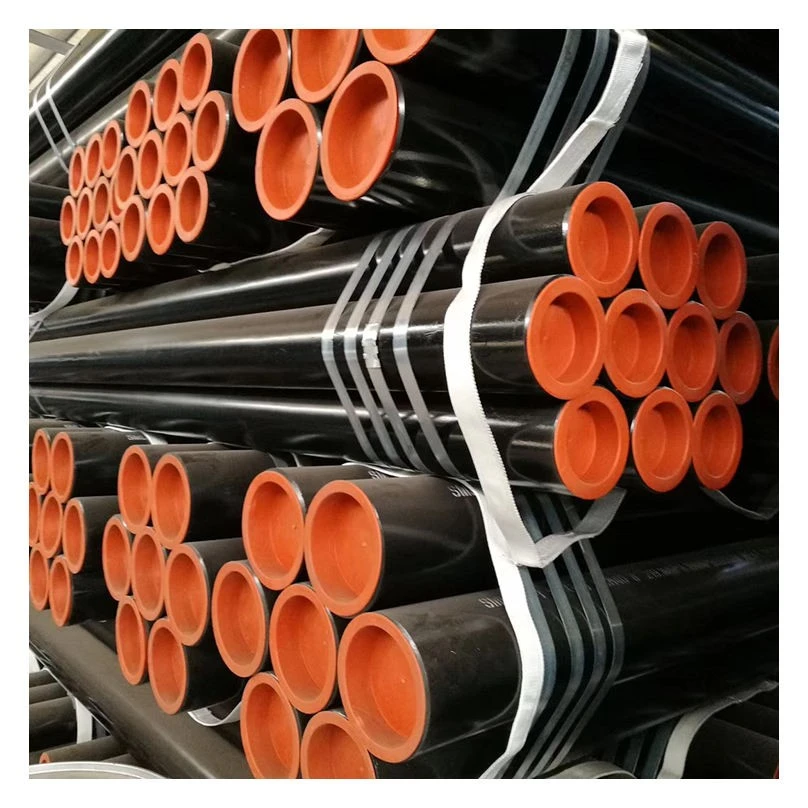
When reviewing the specification sheet of MIDAS carbon steel ERW pipes, many customers notice that our parameter list is more detailed than standard catalogues. This is not just adding figures. Drawing on years of support for municipal water supply & drainage, structural piling, and fluid transmission projects, we focus on easily overlooked specification clauses that often lead to on-site rework, weld leakage, and acceptance disputes.
Wall Thickness Tolerance - Do Not Only Rely on the Standard ±10% Limit
General standards such as ASTM A53 and API 5L specify a wall thickness tolerance of ±10%, which most suppliers only meet as the minimum requirement. During actual pipe fitting, large thickness variation between the two ends of a single pipe easily causes excessive misalignment at fit-up. Welders have to spend extensive time on grinding, and in severe cases the whole pipe section is scrapped.
MIDAS applies stricter internal control for ERW pipes. The wall thickness tolerance is tightened to ±7.5%, while the thickness difference between the head and tail of one pipe is limited to ≤0.2 mm. Consistent wall thickness greatly improves the one-time success rate of field welding, reduces consumption of welding consumables and labour, and ensures hydrostatic test passes on the first attempt.
Weld Quality Stands as the Core Control Point of ERW Pipes
The fundamental difference between ERW pipes and seamless pipes lies in the longitudinal weld. The vast majority of ERW pipe failures across the industry stem from weld defects: incomplete fusion, slag inclusion, fusion offset, and improper control of welding residual stress.
MIDAS implements three weld control procedures which can be specified in acceptance requirements:
100% online eddy current testing along the full weld seam, instead of batch sampling inspection;
Online annealing for the weld heat-affected zone to reduce local hardness and prevent weld cracking during subsequent bending or threading;
Hydrostatic test on samples from each batch under holding conditions exceeding basic standards to verify weld pressure tightness.
During inquiry, you may focus on two key points: the coverage rate of non-destructive testing on welds and whether weld annealing is available.
Impact Test Temperature Must Match Actual Low-temperature Site Conditions
Grades including Q355, L245 and X42 are commonly marked with impact test at 0 °C, which is only suitable for mild environments. For projects in frigid zones, buried low-temperature conditions, or low-temperature media service, the 0 °C impact index cannot resist brittle fracture risks caused by the ductile-brittle transition of carbon steel. Pipe rupture may even occur during pressure testing.
MIDAS can provide low-temperature impact tests at -20 °C or -40 °C according to project conditions, together with third-party test reports. This item slightly raises procurement cost, yet it is far lower than losses caused by pipeline rupture and full-line rectification.
Surface Treatment Scheme Should Align with Downstream Anti-corrosion Processes
It is common practice for bare ERW pipes to be protected with rust-preventive oil. If 3PE coating or epoxy coating will be applied later, mill scale and residual anti-rust oil on pipe surfaces will directly weaken coating adhesion and trigger risks of coating peeling.
MIDAS offers multiple surface status options matched to customers' subsequent processing: Sa2.5 grade sandblasting, weldable primer, or bare pipe delivery. We also adopt separate moisture-proof packaging solutions for sea export and inland transportation. Many projects have encountered heavy rust upon pipe arrival, requiring secondary sandblasting before coating. Defining surface conditions in advance avoids extra process costs.
Full Traceability via Heat Number to Support Third-party Inspection
Each MIDAS carbon steel ERW pipe is marked with stamping including heat number, batch number, dimension, and production information, accompanied by MTC complying with EN 10204 3.1.
Material traceability is a mandatory acceptance threshold for export projects and works supervised by third parties such as SGS and BV. Once non-conformity is found in sampling, we can rapidly locate the inventory scope of the corresponding heat batch and prevent disputes over indiscriminate rejection of the whole shipment.
Rational Selection: Defined Application Boundaries for ERW Pipes
MIDAS objectively clarifies application scenarios and never recommends ERW pipes for service beyond their capacity:
Preferred: Water supply & drainage, fire protection pipelines, structural supports, pile casing and cable protection conduits with outstanding cost performance.
Acceptable under control: Medium and low-pressure fluid service ≤16 bar, conventional oil & gas gathering and municipal gas. Select API 5L PSL1/PSL2 grades with complete NDT and hydrostatic testing for sufficient safety margin.
Not recommended: High-pressure long-distance pipelines, continuous high-temperature service, alternating cyclic loads, wall thickness over 20 mm, and extremely low-temperature severe conditions. Seamless pipes or LSAW pipes are more suitable for such cases.
Many projects previously selected ERW pipes to cut budget for service beyond design limits and ended up replacing the whole pipeline. MIDAS technical team will proactively remind customers of operating risk boundaries during quotation.
Every parameter on the specification sheet corresponds to an on-site procedure, an acceptance check, and a cost item. The core value of MIDAS carbon steel ERW pipes is not attractive figures on paper, but reliable compliance with construction and acceptance requirements after pipes arrive at the site, supporting stable long-term cooperation. Applicable standards cover ASTM A53 Gr.B, API 5L, EN 10219, and GB/T 3091. For specific grades, wall thickness ranges, or cut lengths, contact our technical sales to confirm details based on your project conditions.